
Social media reaches most adult buyers in Oman. According to DataReportal's Digital 2027 report for Oman (October 2026 data), Oman has 5.44 million internet users out of 5.71 million residents, and 3.66 million active social media user identities (79.6 percent of adults aged 18+). Platform ad tools in late 2026 put potential reach in Oman at 3.66 million on YouTube, 3.09 million adults (18+) on TikTok, 2.85 million on Instagram, 2.47 million on Snapchat, 1.75 million on Facebook, and 1.50 million registered members on LinkedIn. DataReportal notes that user identities may not represent unique individuals and LinkedIn counts registered members rather than active users, yet the reach across adult consumers is clear.
Reach alone does not bring sales. To run influencer marketing properly in Oman, handle four things in order: Omani rules, platform disclosure, creator selection, and tracking.
What the rules in Oman say about paid promotion#
Two Omani ministries oversee online promotion and digital media. Check both before signing any creator.
Commercial marketing licence (MOCIIP Decision 619/2022)#
On 21 December 2022 (Official Gazette No. 1473, 25 December 2022), MOCIIP issued Ministerial Decision No. 619/2022 on marketing and promotion via websites and social media, covered in Oman Observer on 4 January 2023:
- Who needs a licence: Anyone paid to market or promote third-party goods or services on websites or social media needs a prior licence from MOCIIP (Article 2). Applicants must operate through a registered commercial company (other than a joint-stock company) and declare each platform they use (Article 3). Decisions take up to 15 days (Article 4), and licences run for three years, renewable (Article 5).
- Who is exempt: Non-profit charity or volunteer work is exempt, as is a merchant promoting goods or services they sell themselves, provided they follow the content rules (Article 2).
- Business check requirement: Article 8 requires any business hiring a promoter to verify that the promoter holds a valid licence.
- Content rules and fines: Licensees must display their licence number, keep claims truthful and clear, respect Omani national identity and culture, and avoid promoting tobacco, counterfeit items, unlicensed projects, or goods lacking required sector approvals (Article 9). Penalties include warnings, fines up to 1,000 OMR, suspension up to one year, or licence cancellation (Article 14).
Media Law and digital media rules (Royal Decree 58/2024 and Decision 165/2025)#
On 10 November 2024, Oman issued the Media Law (Royal Decree No. 58/2024), unifying print, broadcast, and electronic media under the Ministry of Information (MoI). On 11 September 2025 (Official Gazette No. 1613, 14 September 2025), the MoI issued the Executive Regulation (Ministerial Decision No. 165/2025), summarised by Oman Observer on 17 September 2025:
- Social media licences: Articles 89 and 90 govern media-activity licences on social media platforms, requiring applicants to be Omani citizens, declare account details and follower counts, and describe their media content. Article 92 also includes electronic content creators and social media activists among media professions.
- Ad separation and restrictions: Article 74 requires advertisements to be truthful, clearly separated from editorial content, in Arabic, English, or both (where applicable), and free of tobacco, alcohol, or drugs.
- Enforcement: On 4 June 2026, Oman Observer reported an MoI warning that practising licensable digital media activities without approval violates the law. Under Article 141 of Decision 165/2025, penalties include fines up to 10,000 OMR, suspension up to 30 days, or licence cancellation.
Before paying any creator, request their MOCIIP marketing licence number (and MoI licence if they run a regulated media account), confirm the hired handle is listed, and supply sector approvals yourself for regulated medical, financial, or property claims.
Platform rules: disclosure on Instagram and TikTok#
Local licensing does not replace platform disclosure rules. Both Instagram and TikTok require built-in commercial labels.
Instagram: Paid Partnership label#
Meta's Instagram for Creators branded content guide states that creators paid in any form must turn on the Paid Partnership label. Meta explicitly includes non-cash value such as free trips or gifted products.
- Ad boosting: To run a creator's post as a Partnership Ad from your Meta ad account, the creator must grant ad permission when tagging your brand.
- Restrictions: Branded content cannot promote prohibited categories such as drugs and weapons, faces restrictions on categories like alcohol, and cannot embed pre-roll, mid-roll, post-roll, or banner ads.
TikTok: Commercial Content Disclosure setting#
TikTok's Business Help Center (turning on disclosure, January 2026, and creator disclosure rules, April 2026) mandates using the Commercial Content Disclosure toggle whenever a post promotes a brand, product, or service.
- Label choice: Creators choose "Your brand" (Commercial content) for their own business, or "Branded content" (Paid partnership) when paid or incentivised by a third party.
- Reach facts: TikTok cites a 2023 internal study of nearly 2 million videos (tested in Indonesia and Pakistan) showing no performance difference between disclosed and non-disclosed videos. By contrast, undisclosed commercial videos risk losing For You feed distribution unless corrected or appealed within 24 hours.
- Ad authorization: Tagging a brand partner sets a default 60-day authorization period for ads.
Choosing the right tier: nano, micro, or macro influencers#
Do not default to the largest follower count. Match the creator tier to your goal and trackable outcome.
| Tier | Audience focus | Best goal | Relative budget level | What to measure |
|---|---|---|---|---|
| Nano (small, tight-knit community) | Local neighbourhoods, specific hobbies, family or student circles | Trust, product sampling, local footfall, WhatsApp enquiries | Low (product plus modest fee, or multi-creator packs) | Promo code redemptions, WhatsApp clicks, saves, comment questions |
| Micro (focused topic in Oman) | Food, beauty, cars, home decor, fitness, tech, Muscat lifestyle | Lead generation, mid-ticket sales, service launches | Moderate (best in groups of three to five creators) | Cost per click or WhatsApp lead, UTM conversions, code redemptions |
| Macro (broad national reach) | Entertainment, comedy, news commentary, wide family audiences | Mass awareness, mall openings, national seasonal pushes | High (concentrated spend on one or two faces) | Reach, video completion rate, branded search lift, campaign-week visits |
For most SMEs in Oman, three to five micro or nano creators outperform one macro post. You test several creative angles, reach tighter buyer groups, and gain short videos you can boost as paid ads.
A 10-point scoring checklist to vet any creator#
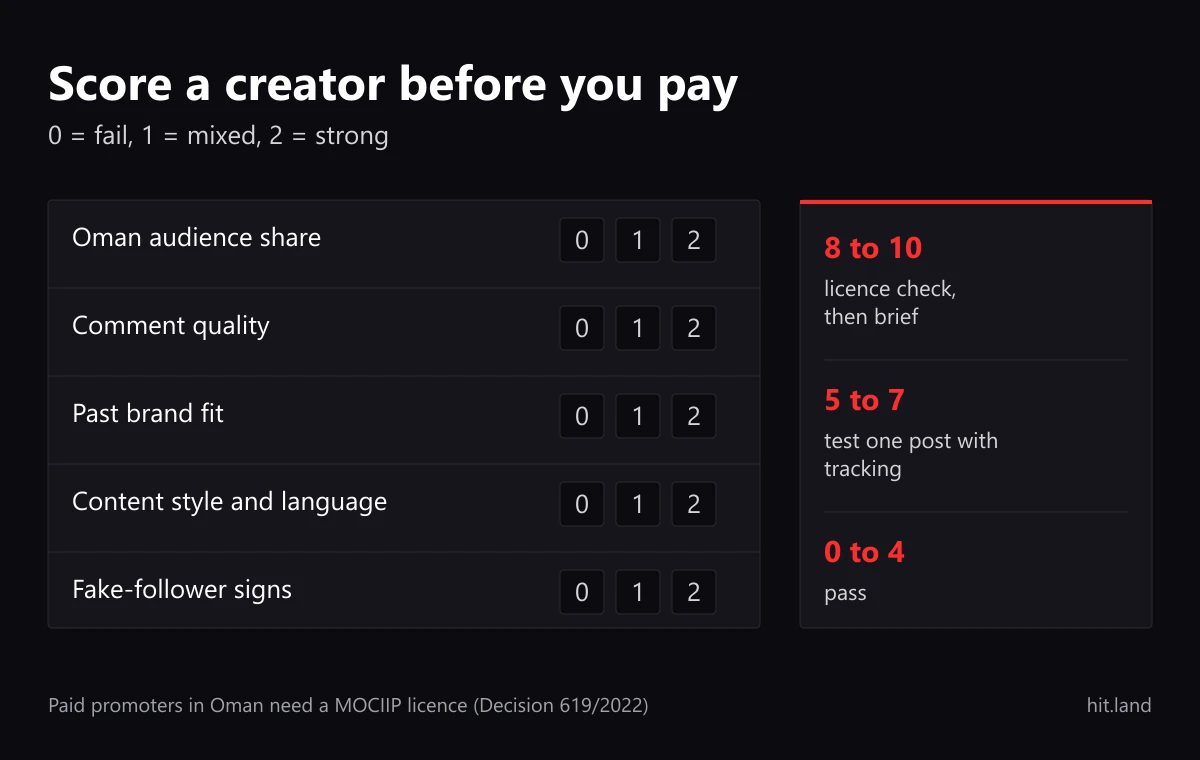
Score each candidate out of 10 before asking for rates. Give 0 for a fail, 1 for mixed evidence, and 2 for a strong pass.
- Oman audience share (0 to 2): Request a screenshot of their last 30 days of Insights showing Top Countries and Top Cities. Score 2 if Oman (and your target city) leads clearly; 0 if most followers sit abroad.
- Comment quality (0 to 2): Read the last 10 posts. Score 2 if real local users ask prices, locations, and details; 0 if replies are generic emojis or mutual creator pods.
- Past brand fit (0 to 2): Check their last three sponsored posts. Did they speak naturally, disclose the partnership properly, and avoid promoting a direct competitor in the last 30 to 60 days?
- Content style and language (0 to 2): Watch videos muted and with sound. Check the first three seconds, lighting, captions, and whether their Arabic or English matches how your actual buyers talk.
- Fake-follower signs (0 to 2): Watch for sudden follower jumps without matching comments, or big accounts with tiny non-giveaway views. Score 2 only when views and local replies hold steady across ordinary posts.
Decision rule: 8 to 10 points means proceed to licensing check and brief; 5 to 7 points means test a single deliverable with strict tracking; 0 to 4 points means pass.
What goes into your brief and contract#
Never run campaigns on casual WhatsApp voice notes. Put six terms in a one-page written agreement before filming:
- Licence details: Creator's MOCIIP marketing licence number (and MoI licence if applicable) covering the hired account.
- Deliverables: Exact Reels, TikToks, Stories, link stickers, language, aspect ratio, and whether raw files are included.
- Approval timeline: Script or talking-points date, rough-cut review with revision rounds, and exact publishing window.
- Disclosure and compliance: Mandatory Instagram Paid Partnership label or TikTok Commercial Content Disclosure toggle, truthful claims, and commercial-safe audio if you plan to boost the video.
- Usage rights and exclusivity: Permission to repost on your own channels and boost as a Partnership Ad or Spark Ad for 60 or 90 days, plus any category exclusivity window.
- Payment terms: Deposit on signing and final balance after the approved post goes live with proper disclosure and an initial Insights screenshot.
How to measure results without guessing#
Views alone do not pay bills. Set up four simple tracking layers before publishing:
- Unique UTM links: Give each creator a tagged URL pointing to a fast, dedicated landing page rather than your homepage.
- Pre-filled WhatsApp links: Use
wa.melinks with a distinct pre-filled message per creator so your sales team can tag incoming chats immediately. - Creator promo codes: Give each creator a short discount or gift code to capture customers who search your name later or visit in person.
- 72-hour baseline comparison: Track walk-ins, calls, and orders over the 72 hours after posting against a normal week.
Common mistakes businesses make in Oman#
- Skipping the licence check: Hiring an unlicensed promoter breaches MOCIIP Decision 619/2022 Article 8. Fix: Collect licence details during onboarding.
- Forgetting ad usage rights: Loving a creator's video but having no right to boost it wastes your best creative. Fix: Write 60 to 90 days of ad authorization into every brief.
- Forcing a corporate script: Rigid scripts kill engagement. Fix: Share three must-say product facts, one call to action, and compliance rules, then let the creator use their own voice.
- Posting without sales readiness: Sending traffic to a slow site or an unstaffed WhatsApp line wastes clicks. Fix: Stagger creator posts across one to two weeks and brief staff beforehand. The same rule applies to any launch: put the big push where customers can buy.
- Chasing follower count: Big giveaway-built accounts rarely convert locally. Fix: Use the 10-point scorecard and verify Oman audience screenshots first.
What to do this week#
- Set one campaign goal: Pick WhatsApp enquiries, online orders, or store visits, and define your success metric.
- Score five to eight creators: Run public profiles through the 10-point scorecard, then request 30-day Insights from your top three or four.
- Verify licences: Confirm MOCIIP (and MoI where relevant) registration before locking dates.
- Send a one-page brief and contract: Cover deliverables, platform disclosure, approvals, 60-day ad rights, and milestone payment.
- Create tracking links and codes: Set up one UTM or WhatsApp link and one promo code per creator.
- Review at day 7: Compare cost per real enquiry or order, and put paid ad spend behind the top-performing video.
What we could not confirm and what nobody can promise#
- Direct ministry portals and member-only translations: We could not open the Ministry of Information portal or Oman News Agency directly due to SSL certificate errors, and Decree.om's English translations of Decisions 619/2022 and 165/2025 require a paid login. We relied on the full Arabic Official Gazette texts published on Qanoon.om and Oman Observer reporting. Confirm current portal steps or take legal advice for regulated sectors.
- Standard rate cards in Oman: No official or independent public source publishes reliable creator pricing benchmarks for Oman, so ask three to five shortlisted creators to quote on identical deliverables.
- Guaranteed sales: No agency or creator can promise that a single post will generate profit. Treat round one as a measured test.
FAQ#
Do businesses in Oman need a marketing licence to post on their own pages?#
No. Article 2 of MOCIIP Decision 619/2022 exempts merchants promoting the goods or services they sell or provide themselves, though they must still follow the regulation's content and honesty rules.
Is a business responsible if a hired influencer lacks a licence?#
Yes, you carry compliance risk. Article 8 of MOCIIP Decision 619/2022 explicitly requires businesses promoting goods or services to verify that the promoter holds a valid licence.
Should we focus on Instagram, TikTok, or Snapchat in Oman?#
Pick the platform that fits your buyer and format. In DataReportal's late 2026 ad-reach figures for Oman, TikTok (3.09 million adults 18+), Instagram (2.85 million), and Snapchat (2.47 million) all hold large audiences alongside YouTube (3.66 million).
Does TikTok's Paid Partnership toggle reduce reach?#
TikTok says no. Its April 2026 creator help page cites an internal study of nearly 2 million videos showing no performance drop when commercial content is properly disclosed, whereas hiding commercial intent can make a post ineligible for the For You feed.
Can we run paid ads using a creator's post?#
Yes, if your contract includes usage rights and the creator enables brand partner ad authorization in the app. TikTok's default ad authorization window is 60 days, and Instagram requires creator approval before you can boost the post.
How many creators should a small business test first?#
Start with two to four micro or nano creators using separate tracking codes rather than putting your whole budget on one large account. Comparing multiple voices quickly shows which audience converts.
Sources#
- DataReportal, "Digital 2027: Oman" (October 2026 data): https://datareportal.com/reports/digital-2027-oman
- Ministry of Commerce, Industry and Investment Promotion (MOCIIP), Ministerial Decision No. 619/2022 (21 December 2022, Official Gazette No. 1473, via Qanoon.om): https://qanoon.om/p/2022/mociip20220619/
- Oman Observer, "New social media marketing rule 'aimed at regulating' influencers'" by Vinod Nair (4 January 2023): https://www.omanobserver.om/article/1130811/business/markets/new-social-media-marketing-rule-aimed-at-regulating-influencers
- Royal Decree No. 58/2024 Issuing the Media Law (10 November 2024, Official Gazette No. 1570, via Qanoon.om): https://qanoon.om/p/2024/rd2024058/
- Ministry of Information, Ministerial Decision No. 165/2025 Issuing the Executive Regulation of the Media Law (11 September 2025, Official Gazette No. 1613, via Qanoon.om): https://qanoon.om/p/2025/moi20250165/
- Oman Observer, "MoI sets rules to regulate media activities in Oman" by Zakiya Al Hussaini (17 September 2025): https://www.omanobserver.om/article/1176678/oman/moi-sets-rules-to-regulate-media-activities-in-oman
- Oman Observer, "MoI issues reminder on mandatory licensing for media activities" (4 June 2026): https://www.omanobserver.om/article/1190716/oman/moi-issues-reminder-on-mandatory-licensing-for-media-activities
- Instagram for Creators (Meta), "Partner With Brands and Earn" / Branded Content (2026): https://creators.instagram.com/earn-money/branded-content?locale=en_US
- TikTok Business Help Center, "How to turn on the Commercial Content Disclosure setting in TikTok" (January 2026): https://ads.tiktok.com/resources/help/article/how-to-turn-on-the-commercial-content-disclosure-setting-in-tiktok
- TikTok Business Help Center, "About the Commercial Content Disclosure setting for creators" (April 2026): https://ads.tiktok.com/resources/help/article/about-the-content-disclosure-setting-for-creators
If you want help vetting creators, setting up briefs, and tracking results across a campaign in Oman, see our influencer marketing service.
Related case studies
Real projects where we applied the ideas in this article.
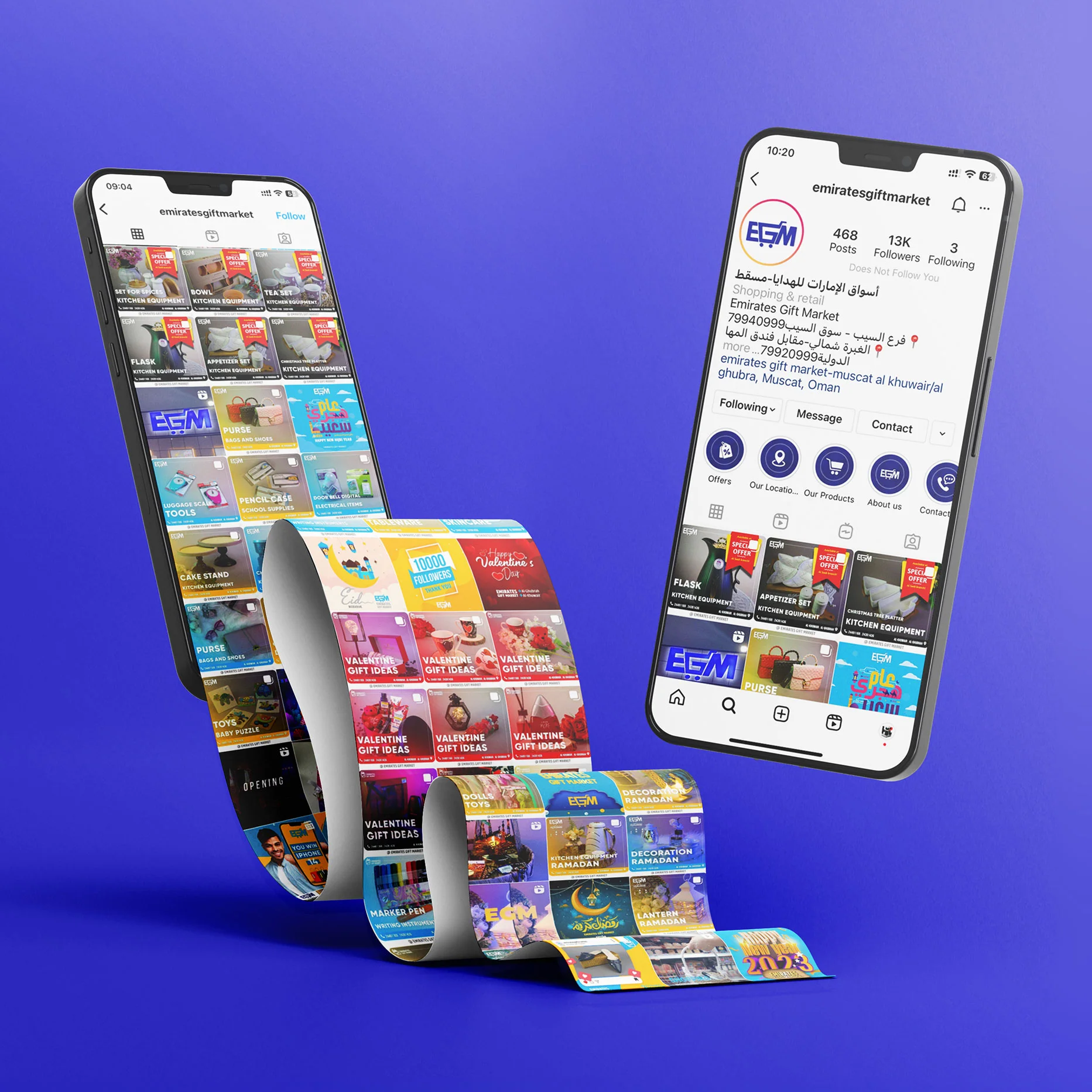
Instagram Content Marketing — Emirates Gift Market
A comprehensive Instagram marketing strategy for Emirates Gift Market, combining high-end videography, motion…
View case study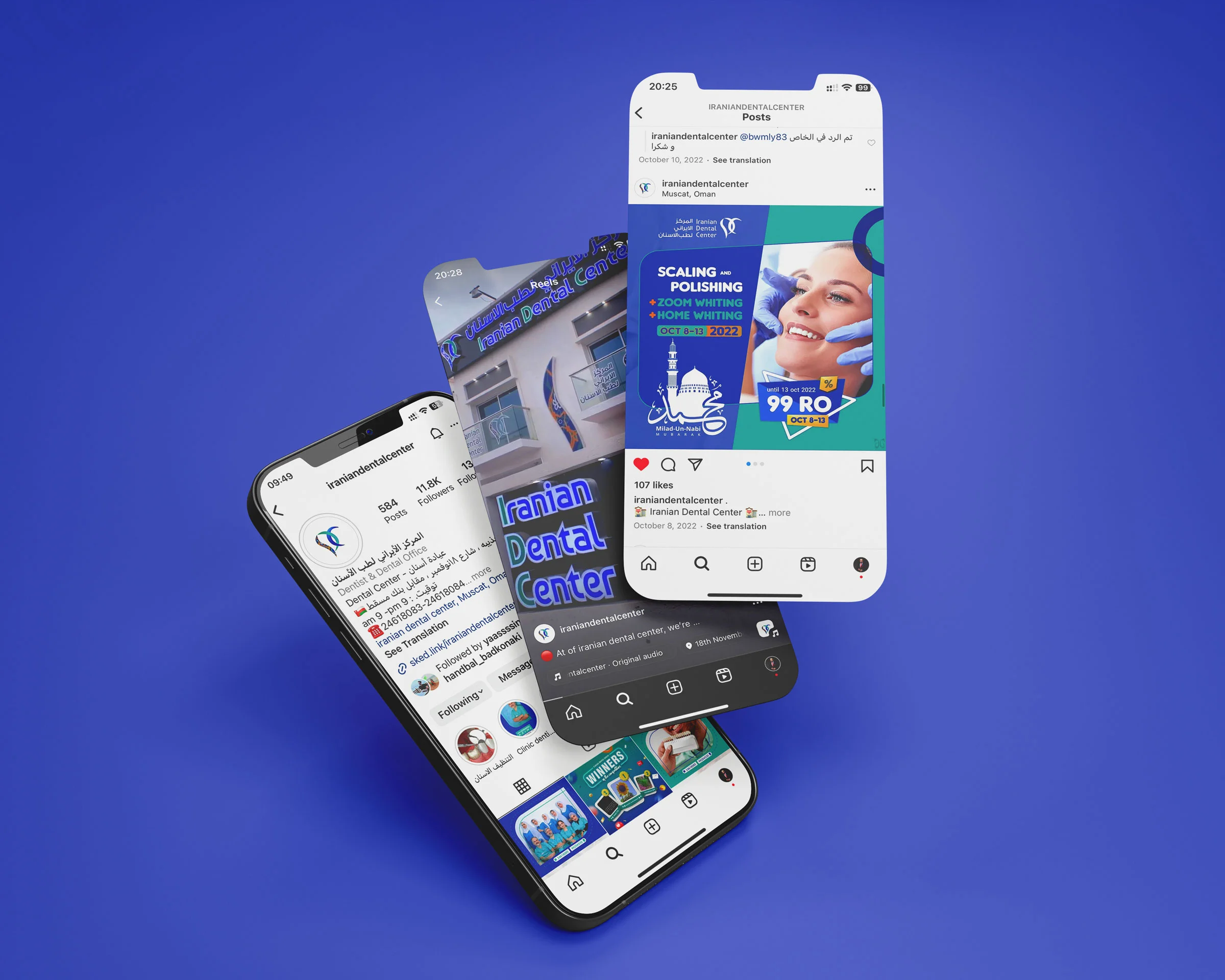
Social Marketing — IDCM Dental Center, Muscat
A comprehensive Instagram content marketing strategy for IDCM Dental Center, Muscat, focusing on patient engagement…
View case study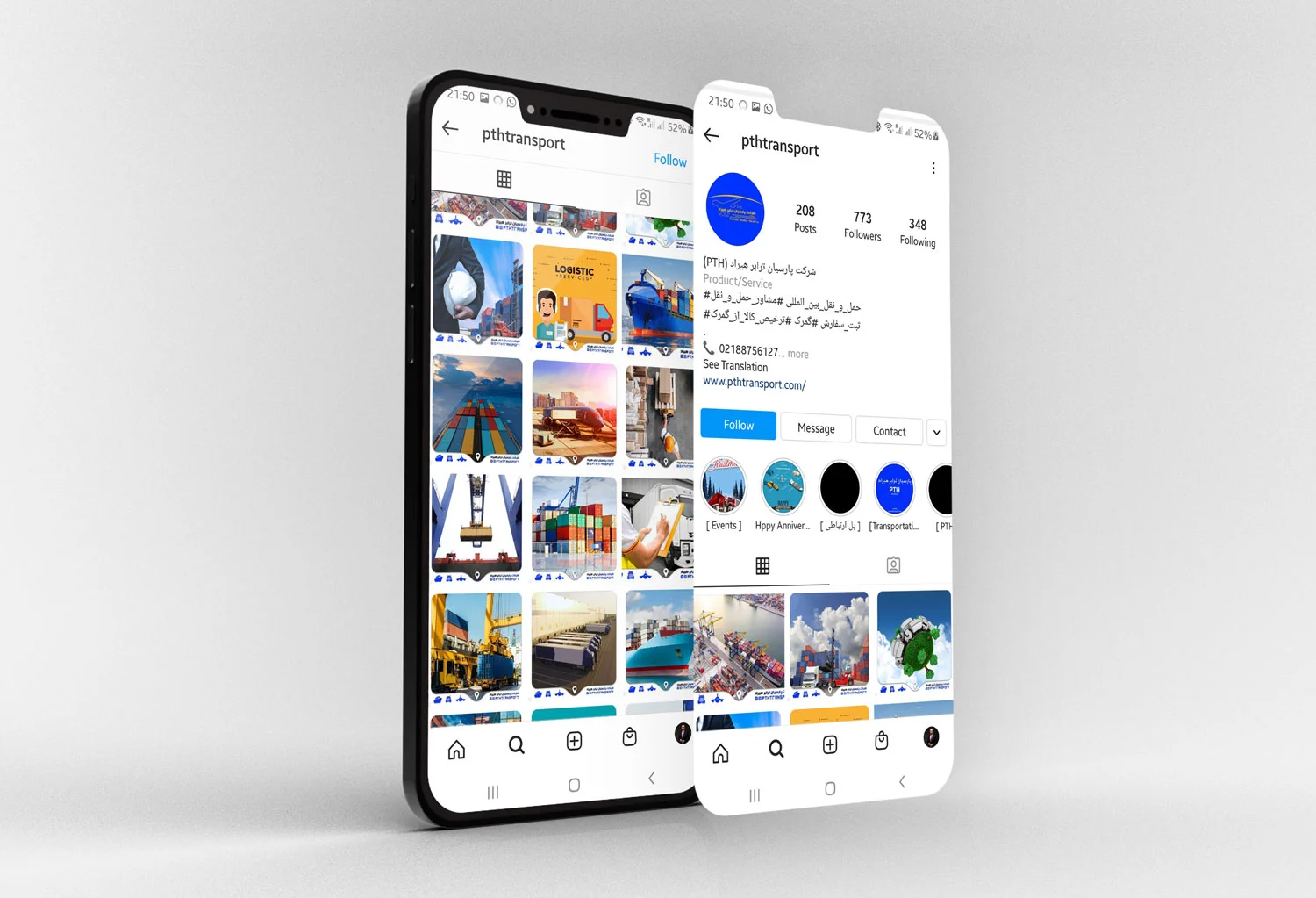
Instagram Content Marketing — PTH Transport
A comprehensive social media strategy for PTH Transport, utilizing motion graphics and professional design to elevate…
View case study