

What the rules say#
ICANN's FAQ puts it plainly: you do not "own" a domain name. What you are doing is more like leasing. A domain has to be renewed, like a lease.
Under ICANN's transfer policy, the Registered Name Holder is the only party that has the authority to approve or deny a transfer request. If the domain is in your designer's name, the right to approve a transfer sits with them, not with the person who paid.
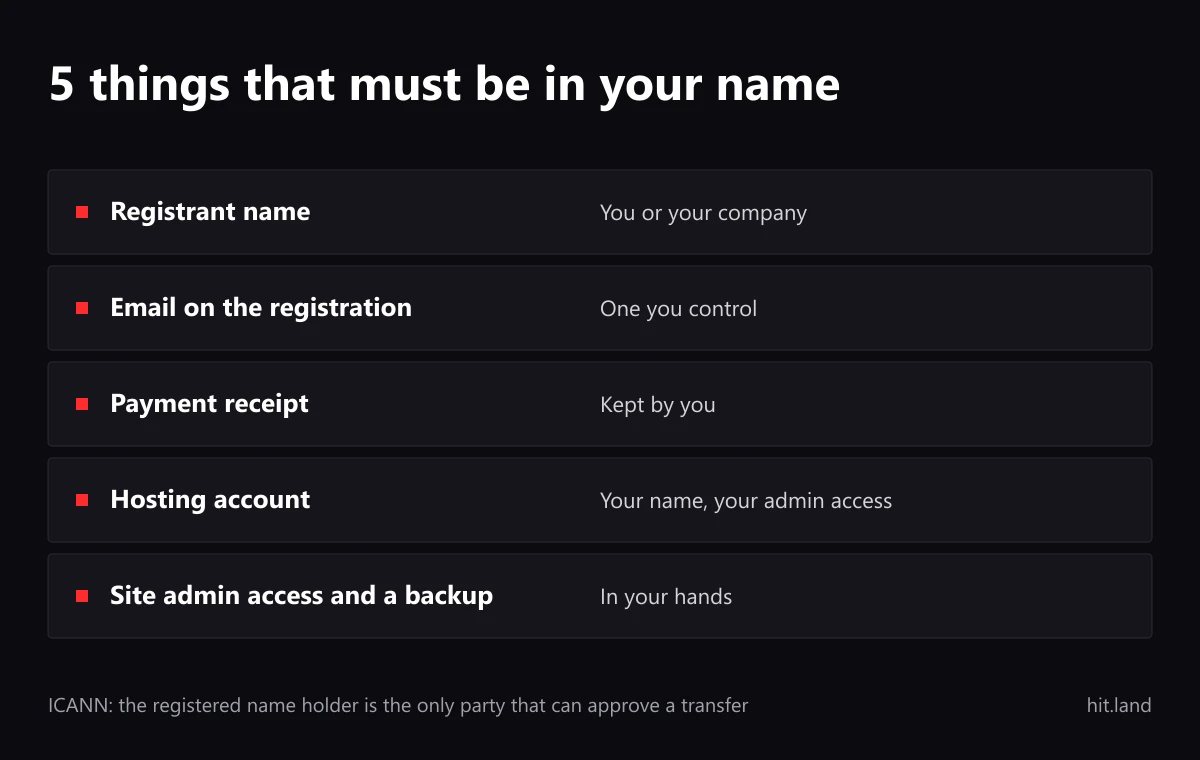
The five things that must be in your name or in your hands:
| # | What | Should be | Source |
|---|---|---|---|
| 1 | Registrant name | You or your company | ICANN FAQ: a designer may register with their own details |
| 2 | Email on the registration | An email you control, not your designer's or a former employee's | ICANN: the holder must keep details accurate; ICANN: expiry notices go to the registrant |
| 3 | Payment receipt and registrar invoices | Kept by you | ICANN FAQ: you may need to provide proof of your payment |
| 4 | Hosting account | In your name, with your admin access | Our practice. No official source |
| 5 | Site admin access and a backup | In your hands | Our practice. No official source |
Renewal has its own dates. For generic domains such as .com, registrars must notify the registrant at least two times before expiry, about one month and about one week before (ICANN). After expiry, a registrar may offer a renewal period of up to 45 days, and a 30-day redemption period follows deletion.
Fix the registrant early, while the relationship is good, not on the day you need to move the site.
In the UK, an independent expert ordered a domain that a web developer had registered for a company to be moved to that company (Chubb Bulleid, undated).
For Oman, the IANA record for .om names the Telecommunications Regulatory Authority (TRA) as the manager of the registry.
What we see with clients#
We see this often. A business launched its website years ago and let someone else register the domain. Now it wants a change. There is no password, and that person does not reply. The site is there, but it is not theirs.
To be fair, some designers keep the domain on purpose, as leverage when a client stops paying. We have had clients who did not pay too. We try not to use the domain as leverage.
When we register a domain for a client, we take three things from them: their own email, their own phone number, and, for a company, its commercial registration. The domain is registered in the client's name, so if we are no longer around, the client has the documents to ask the registrar for the domain back.
What to do this week#
- Ask your designer one question: "Whose name and which email is my domain registered under?"
- If it is not your name or your email, fix it now, while the relationship is good.
- Keep the payment receipt for the domain. It may be the proof you need one day.
- Check the registration yourself on ICANN's lookup tool. Some details can be hidden for privacy, so the receipt and your designer's answer still matter.
- Ask who receives the renewal reminder emails. Make it an email you check.
- Make a list of your domain, hosting and social accounts: who owns each one and who holds its password.
What we could not confirm#
- Oman's own rules: we could not open the TRA pages with the official rules for registering or transferring a .om domain. Check them before you register.
- Conflicting sources on .om: two sources disagree on which companies may register .com.om and similar names. We have not used either version.
- How common this is: we found no reliable figure for how many domains designers hold for their clients.
FAQ#
Does paying for a domain make it mine?#
Not by itself. ICANN says the registrant is the party that holds the rights to the domain. A designer may register it with their own contact details, even if you paid them.
How can I check who owns my domain?#
Use ICANN's free lookup tool at lookup.icann.org. It shows registration data using the RDAP protocol. Some details can be hidden for privacy, so keep your receipt and ask your designer as well.
Who can approve a transfer?#
Only the registered name holder. ICANN's transfer policy says that party is the only one with the authority to approve or deny a transfer request.
What if my designer does not answer?#
Contact the registrar that holds the domain. ICANN's FAQ says you may need to provide proof of your payment, so keep it ready. ICANN also has a complaint form for transfer problems.
Why do I need to renew a domain I paid for?#
ICANN describes a domain as something you lease, not something you buy. For generic domains such as .com, registrars must send at least two expiry notices before the due date, so make sure they go to an email you check.
Can I register a .om domain?#
Check the current rules of the TRA, which manages .om, and an authorised registrar before you register. We register .om domains with the client's own details and commercial registration, which is our practice.
Sources#
- ICANN, General Questions (registrant, "you do not own", designer may use own details, proof of payment): https://www.icann.org/resources/pages/faqs-84-2012-02-25-en
- ICANN, Registrants' Benefits and Responsibilities (accurate details): https://www.icann.org/resources/pages/benefits-2013-09-16-en
- ICANN, Transfer Policy (registered name holder approves transfers): https://www.icann.org/en/contracted-parties/accredited-registrars/resources/domain-name-transfers/policy
- ICANN, 5 things about the Expired Registration Recovery Policy: https://www.icann.org/resources/pages/registrant-about-errp-2018-12-07-en
- ICANN, Expired Registration Recovery Policy (two notices): https://www.icann.org/resources/pages/errp-2013-02-28-en
- ICANN, updated Lookup tool (RDAP, privacy redaction): https://www.icann.org/en/blogs/details/updated-lookup-tool-for-domain-name-registration-data-now-available-29-7-2019-en
- ICANN Compliance, complaint form: https://www.icann.org/compliance/complaint
- IANA, delegation record for .om: https://www.iana.org/domains/root/db/om
- Chubb Bulleid, "Company Recovers Domain Name from Web Developer": https://www.chubb-bulleid.co.uk/insights/legal-library/commercial-client/company-recovers-domain-name-from-web-developer/
For the hosting side of your site, see HiT Cloud.
Related case studies
Real projects where we applied the ideas in this article.
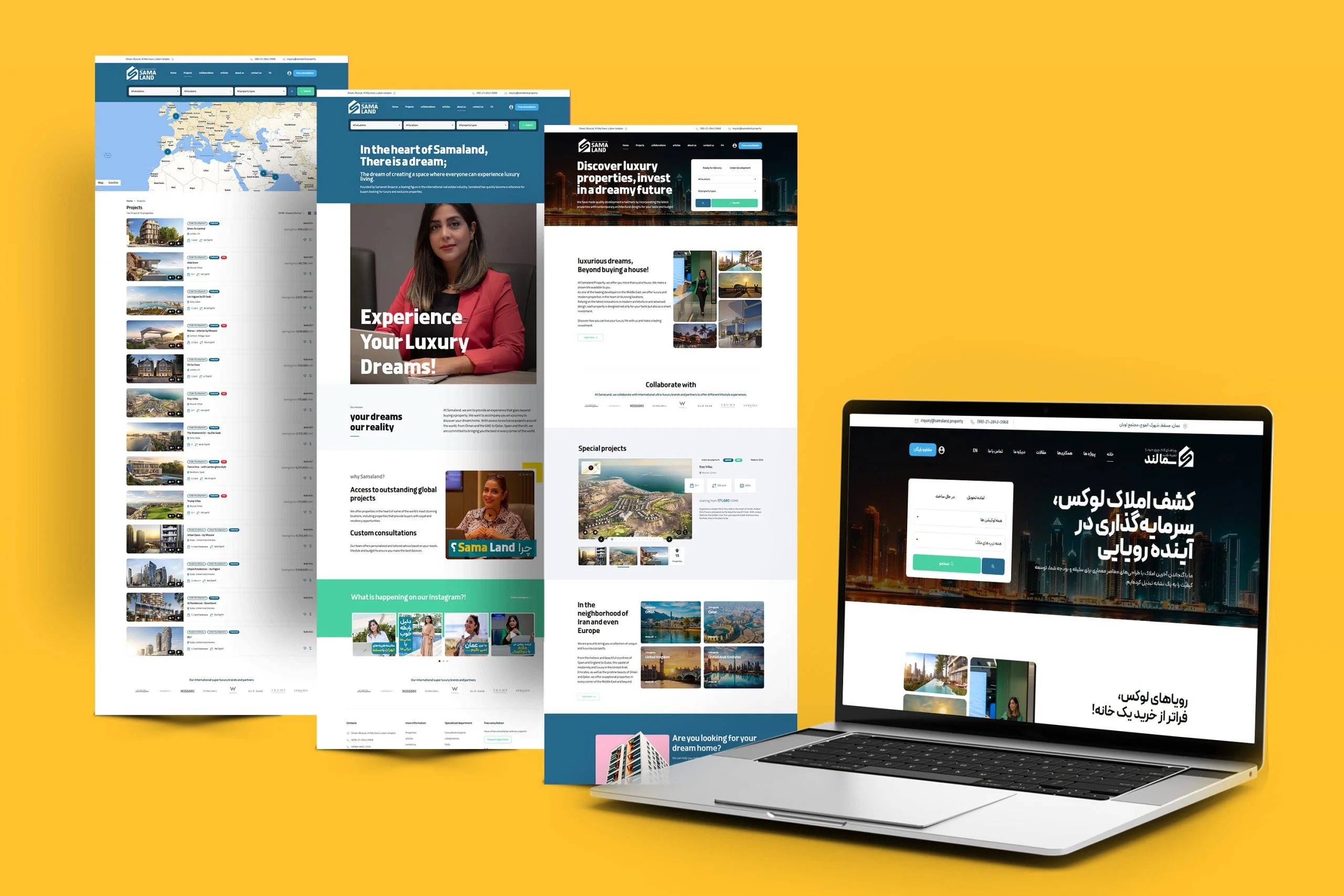
Real Estate Website — Sama Land
A premium digital platform for an Omani real estate leader, combining high-end visual design with seamless property…
View case study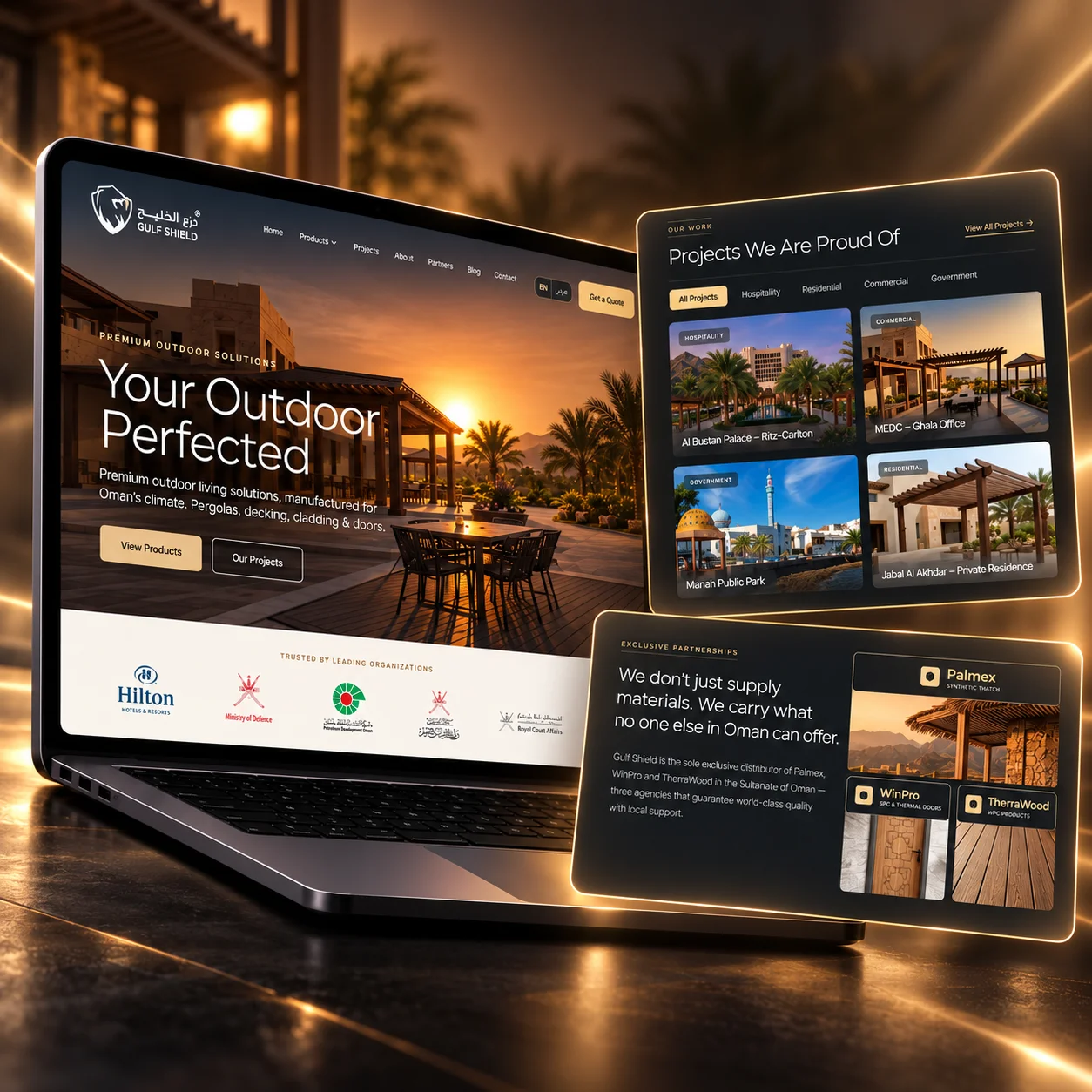
Website Design — Gulf Shield
A premium custom website and specialized CMS developed for Oman's leading provider of high-end outdoor living and…
View case study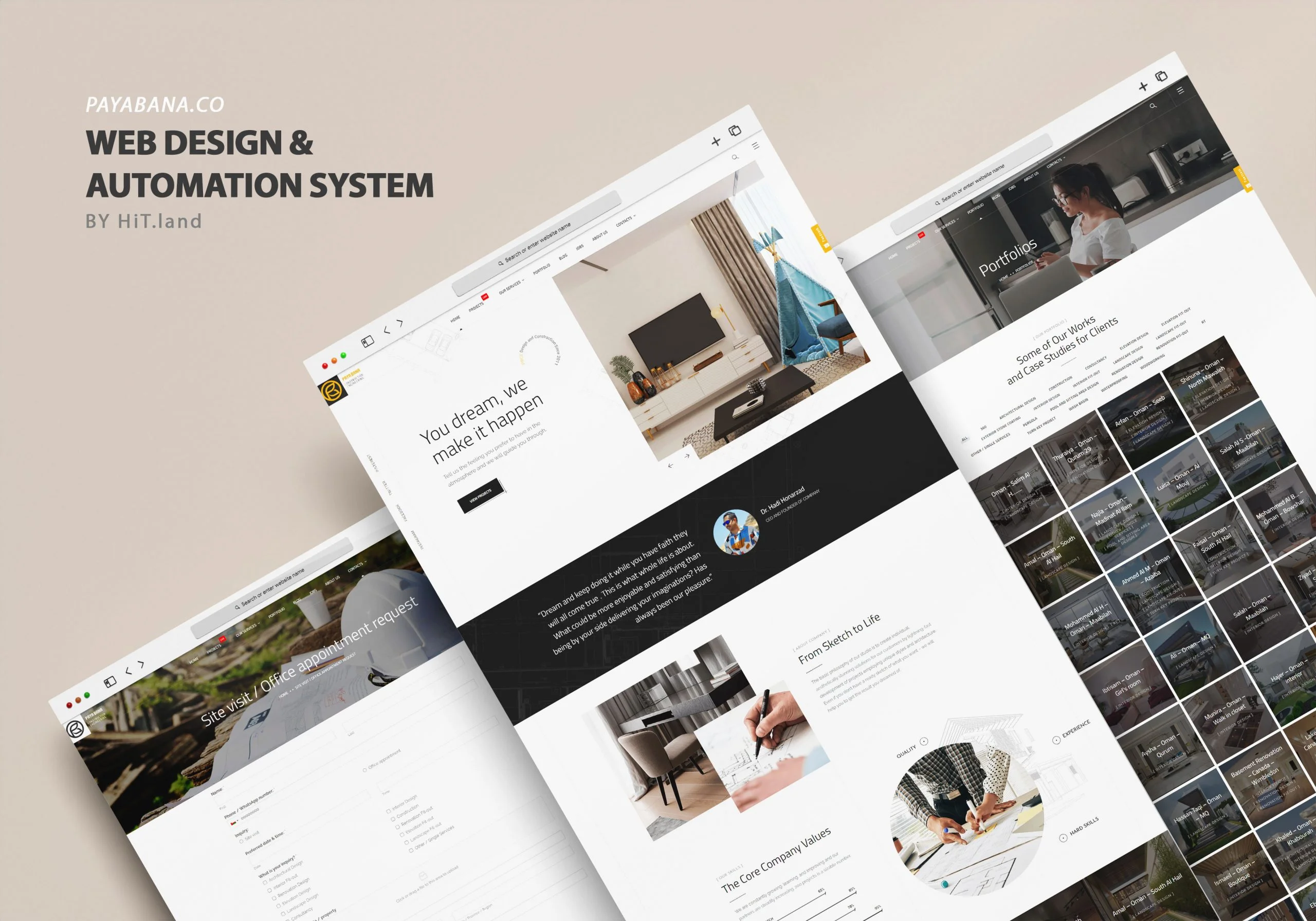
Website & Digital Marketing — Paya bana
A comprehensive digital transformation for Paya bana, featuring custom web development and integrated marketing…
View case study